
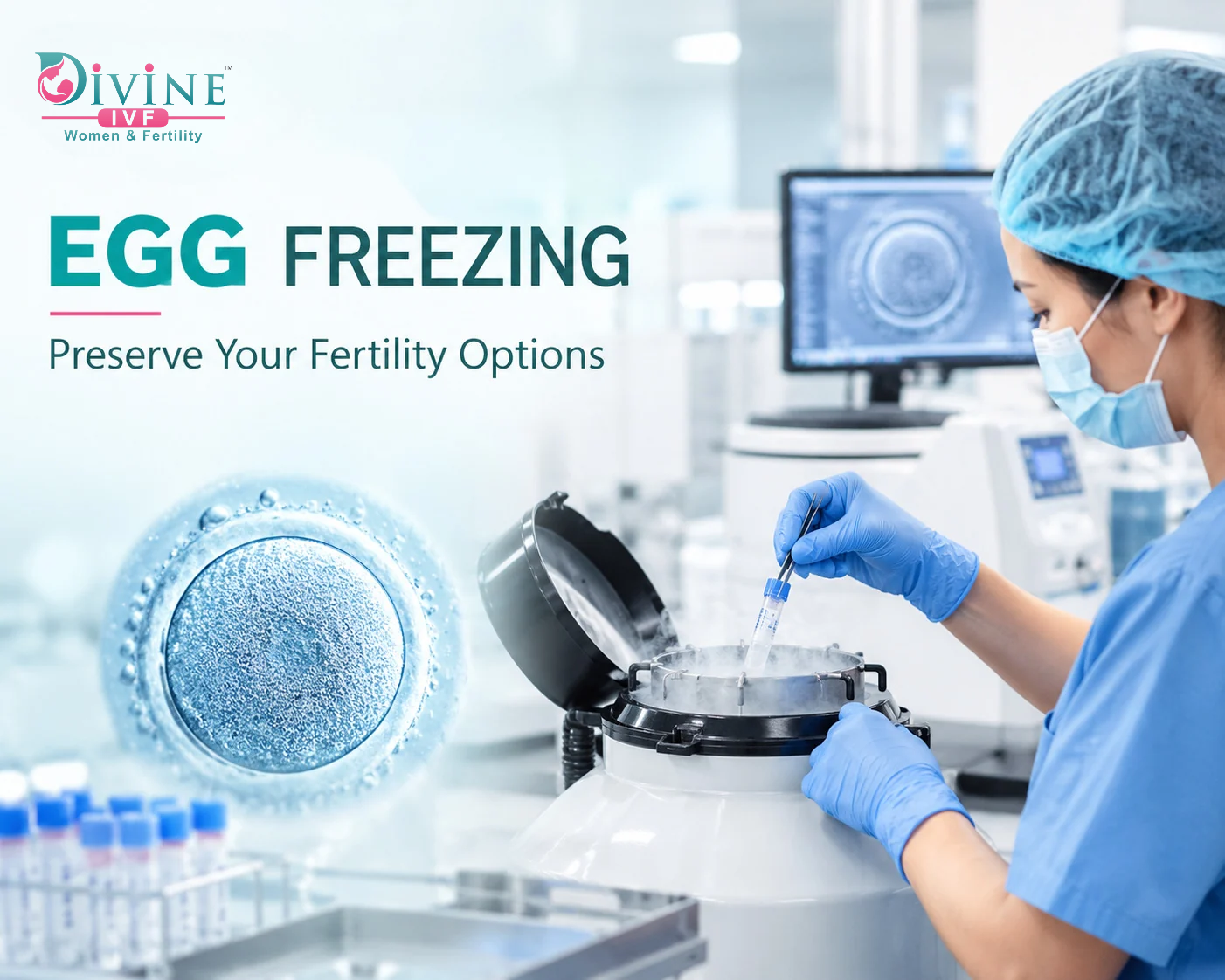
Egg Freezing: Process, Benefits, Age Considerations & Important Things to Know.
Introduction
Egg freezing — medically known as oocyte cryopreservation — has changed the conversation around fertility. It offers women the option to preserve younger, healthier eggs and use them later, whether for personal, medical, or professional reasons.
But egg freezing is not a simple "insurance policy." It involves a multi-step medical process, significant time commitment, and important decisions about timing. Understanding what egg freezing can and cannot do is essential before you begin.
At Divine IVF, Noida, led by Dr. Mandavi Rai, fertility preservation is approached with the same personalised, evidence-based care as every other treatment — with honest counselling about realistic outcomes.
What is Egg Freezing?
Egg freezing is a procedure where mature eggs are retrieved from the ovaries, frozen using a rapid technique called vitrification, and stored for future use. When you are ready to attempt pregnancy, the eggs are thawed, fertilized with sperm in the laboratory (usually through ICSI), and the resulting embryo is transferred to the uterus .
The process is essentially the first half of an IVF cycle — ovarian stimulation and egg retrieval — without immediate fertilization. The eggs are paused in time until you decide to use them.
How Egg Freezing Works: Step by Step
Step 1: Initial Assessment and Consultation
Before starting, your fertility specialist will assess your ovarian reserve through blood tests (AMH, FSH) and an ultrasound to count antral follicles. This helps estimate how many eggs you may be able to retrieve and guides the medication protocol .
Step 2: Ovarian Stimulation
You will self-administer hormone injections (typically 2–3 per day) for 10–12 days to encourage multiple eggs to mature simultaneously, rather than the single egg produced in a natural cycle . Your doctor will adjust the dosage based on your age, ovarian reserve, and response.
Step 3: Monitoring
During stimulation, you will attend several clinic visits — usually every 2–3 days — for blood tests and ultrasound scans. These track follicle growth and hormone levels, allowing your doctor to time the trigger injection precisely .
Step 4: Trigger Injection and Egg Retrieval
When follicles reach the right size, a "trigger shot" is given to finalise egg maturation. Egg retrieval is scheduled 34–36 hours later .
The retrieval is a short outpatient procedure, typically lasting 15–30 minutes, performed under sedation. A thin needle is guided through the vagina into the ovaries to collect the eggs . Most women experience mild cramping for a day or two and can return home the same day.
Step 5: Vitrification and Storage
Mature eggs are frozen using vitrification — an ultra-rapid freezing method that prevents ice crystals from forming and damaging the delicate egg cells. The eggs are then stored in liquid nitrogen at approximately -196°C .
Step 6: When You Are Ready
When you decide to use your eggs, they are thawed, fertilized with sperm (often via ICSI, as the egg's outer layer can harden after freezing), and cultured into embryos for transfer .
Who Can Benefit from Egg Freezing?
Egg freezing may be considered for several reasons:
Medical Fertility Preservation
Before cancer treatment (chemotherapy or radiation can damage ovarian function)
Before surgery that may affect the reproductive organs
Medical conditions that threaten ovarian reserve, such as severe endometriosis or a family history of early menopause
Personal and Lifestyle Reasons
Not ready for parenthood now but want to preserve the option
No current partner and prefer not to use donor sperm
Career or life circumstances that make earlier pregnancy impractical
At Divine IVF, fertility preservation is offered as part of comprehensive reproductive care, with counselling tailored to each woman's medical and personal situation.
Age Considerations: Why Timing Matters So Much
Age is the single most important factor influencing egg freezing success. Egg quantity and quality decline naturally over time, and this decline accelerates after age 35 .
The General Timeline
20s to early 30s: Eggs are generally at their highest quality and quantity. Fewer eggs may be needed to achieve a good chance of future pregnancy .
35–37: A more progressive decline in egg quality begins. More eggs may be needed, and more than one cycle may be required .
37–40: Decline becomes more significant. Success rates using frozen eggs drop noticeably when eggs are frozen in this window .
40 and above: Egg yield per cycle tends to be lower, and elective freezing becomes less efficient. Some clinics do not recommend egg freezing for women over 38 for elective reasons .
What the Numbers Suggest
A woman who freezes 20 eggs at age 30 may have approximately a 60–70% chance of at least one live birth later. A 38-year-old woman may need 30 or more eggs to approach similar odds, often requiring multiple cycles .
One study found that freezing at least 20 mature eggs before age 38 yielded a 70% chance of at least one live birth . Another analysis showed that among women who froze eggs at 35 or younger, cumulative live birth rates exceeded 90% — but this required utilising 24 eggs, often from more than one cycle .
The Honest Truth
Egg freezing is not a guarantee. Not all frozen eggs survive thawing, fertilize, or develop into viable embryos. Even high-quality embryos may not implant. Age at freezing remains the strongest predictor of success .
Benefits of Egg Freezing
Preserves younger eggs: Eggs frozen in your 20s or early 30s retain the quality of that age, even if used years later .
Reduces pressure: Offers flexibility for women who are not ready to start a family now .
Medical safety net: Provides options before fertility-damaging treatments .
No increased risk of abnormalities: Studies show no difference in birth defect rates between babies born from frozen eggs versus fresh eggs .
Established technology: Vitrification is no longer experimental — it is a routine and reliable method in experienced laboratories .
Important Things to Know Before You Decide
It Is Not a Guarantee
Egg freezing improves your options but does not ensure a pregnancy. Some eggs will not survive thawing, fertilizing, or developing into embryos suitable for transfer .
You May Need More Than One Cycle
To reach the number of eggs associated with good success rates, especially after age 35, multiple stimulation cycles may be necessary. This affects both cost and time commitment .
The Return Rate Is Low
Studies show that only a minority of women who freeze eggs — often around 10–15% — actually return to use them . This is not a reason to avoid freezing, but it is important context for decision-making.
Side Effects Exist
Hormone injections can cause bloating, headaches, mood changes, and pelvic discomfort. A rare but serious risk is ovarian hyperstimulation syndrome (OHSS), which your doctor will monitor for and take steps to prevent .
Storage Limits and Costs
In India, eggs can generally be stored for up to 10 years under current regulations, with possible extensions through proper documentation . Storage fees apply, and the later process of thawing, fertilization, and embryo transfer involves additional costs.
Quality of the Lab Matters
Vitrification requires skill and precision. An experienced embryology laboratory is essential for good survival rates after thawing. Ask about the clinic's specific outcomes and lab standards.
Why Consider Divine IVF for Fertility Preservation?
At Divine IVF, Sector 76, Noida, fertility preservation is offered under the direct guidance of Dr. Mandavi Rai, who brings 15+ years of fertility experience and a commitment to honest, individualised care.
The clinic's approach is built on:
Doctor-led planning at every step
Clear communication about realistic outcomes — not false promises
Advanced laboratory standards for vitrification and storage
Comprehensive fertility care under one roof, from initial assessment through to future embryo transfer
As Dr. Rai believes: "There is no one-size-fits-all path to parenthood. My role is to understand, guide and support you with the right care, at the right time."
FAQs
What is the best age to freeze eggs?
The best time is generally in your 20s to early 30s, when egg quality and quantity are highest. Freezing before age 35 is widely recommended, though the right timing depends on your personal circumstances and ovarian reserve .
How successful is egg freezing?
Success depends primarily on age at freezing and number of eggs stored. Freezing 20 eggs at age 30 may offer a 60–70% chance of at least one live birth later. Success rates decline significantly when eggs are frozen after age 37 .
How many eggs should I freeze?
Many specialists suggest aiming for 15–20 mature eggs for a reasonable chance of future pregnancy, though women in their late 30s may need more — often 30 or more — to achieve similar outcomes .
Is egg freezing painful?
The retrieval procedure is performed under sedation, so you will not feel pain during it. Most women experience mild cramping afterward, similar to period pain, for a day or two .
Can I freeze eggs if I am over 35?
Yes, egg freezing is still possible after 35, but success rates are lower, and more cycles may be needed to collect enough eggs. A fertility assessment can help you understand your individual odds .
Does egg freezing damage the eggs?
Modern vitrification is designed to minimise damage. In experienced laboratories, post-thaw survival rates can exceed 90% for vitrified eggs . Older slow-freezing methods caused more ice crystal damage; vitrification has largely solved this problem.
Conclusion
Egg freezing is a powerful option for preserving fertility, but it works best when approached with accurate information and realistic expectations. Age matters — not just for success rates, but for how many cycles you may need and what the process will involve.
If you are considering egg freezing, the first step is a thorough fertility assessment and an honest conversation with a specialist who will explain what your individual chances look like — not just general statistics.
Book a consultation with Dr. Mandavi Rai at Divine IVF, Sector 76, Noida, to discuss whether egg freezing is right for you and to build a personalised fertility preservation plan.
📞 Your future family deserves a well-informed beginning.
Disclaimer: Fertility preservation outcomes vary by individual medical profile. This information is for educational purposes and is not a substitute for personalised medical advice. Consult a qualified fertility specialist for guidance specific to your situation.