ICSI Treatment: How It Works & When It May Be Recommended During IVF
Introduction
If you are exploring IVF, you have likely come across the term ICSI — Intracytoplasmic Sperm Injection. It is often mentioned alongside IVF, sometimes as if it is a standard upgrade. But is it? And do you actually need it?
The truth is, ICSI is a remarkable laboratory technique that has helped countless couples overcome severe male infertility. However, it is not automatically necessary for every IVF cycle. Understanding how ICSI works and when it is genuinely recommended empowers you to have an informed conversation with your fertility specialist — rather than simply accepting a "just to be safe" approach.
At Divine IVF, Noida, led by Dr. Mandavi Rai, the decision to use ICSI is always based on your specific clinical picture, not a blanket protocol. This guide explains exactly what ICSI involves and when it can make a real difference.
What is ICSI?
ICSI stands for Intracytoplasmic Sperm Injection. It is a specialised laboratory procedure performed during an IVF cycle.
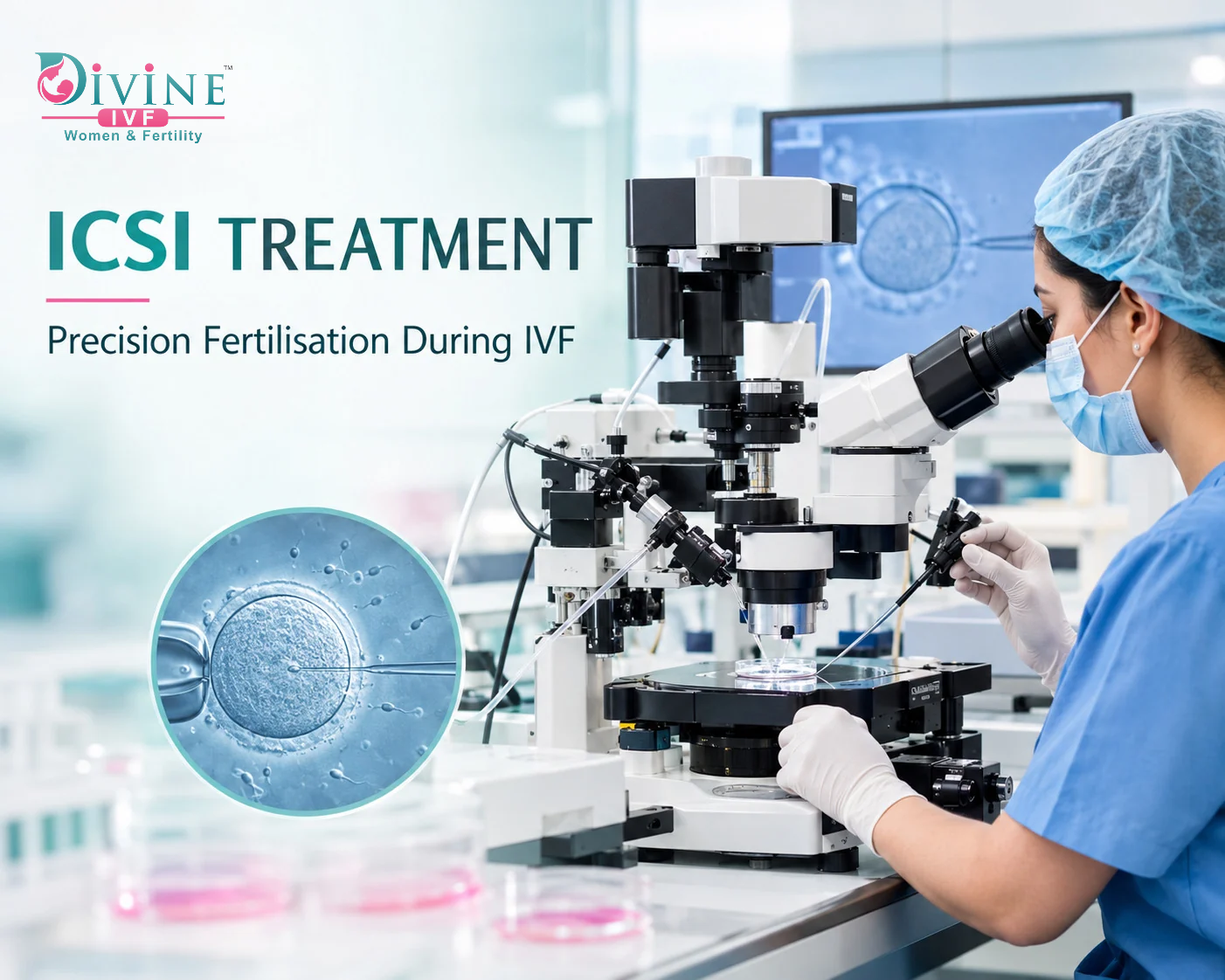
In standard IVF, eggs and sperm are placed together in a dish, and fertilization happens naturally — the sperm must swim to the egg and penetrate its outer layer on its own. In ICSI, an embryologist selects a single healthy-looking sperm and injects it directly into the centre of a mature egg using a tiny needle .
This bypasses the need for sperm to swim or penetrate the egg, making it a powerful option when sperm quality or function is compromised.
How ICSI Works: Step by Step
ICSI is not a separate treatment from IVF — it is a modification of the fertilization step. Here is how the process unfolds:
Step 1: Ovarian Stimulation and Egg Retrieval
The female partner undergoes the same preparation as standard IVF. Hormone injections are given for about 1 to 2 weeks to stimulate the ovaries to produce multiple mature eggs. Blood tests and ultrasounds monitor follicle development closely .
Once follicles are ready, a trigger shot (hCG) is given, and eggs are retrieved 34 to 36 hours later through a minor procedure guided by ultrasound .
Step 2: Sperm Collection and Preparation
The male partner provides a sperm sample on the day of egg retrieval. In cases where sperm are not present in the ejaculate (azoospermia) or cannot be ejaculated due to a blockage or other issue, sperm may be surgically retrieved from the testicle or epididymis through a small procedure .
The sample is then prepared in the lab to separate healthy, motile sperm from debris and non-viable cells.
Step 3: The Injection
This is the core of ICSI. Under a high-powered microscope, the embryologist:
Holds a mature egg steady with a micropipette
Selects a single, morphologically normal sperm
Immobilises the sperm and draws it into a fine needle
Injects the sperm directly into the cytoplasm of the egg
Only mature eggs are injected, as immature eggs are less likely to fertilize normally .
Step 4: Fertilization Check and Embryo Development
After injection, the eggs are cultured in the lab. The next day, they are checked for signs of fertilization. Successfully fertilized eggs are monitored for 3 to 5 days as they develop into embryos .
Step 5: Embryo Transfer
The best-quality embryo (or embryos) is selected and transferred into the uterus using a thin catheter. Any remaining suitable embryos can be frozen for future use .
When Is ICSI Actually Recommended?
This is the most important part. ICSI is not a universal add-on. Leading reproductive bodies, including the American Society for Reproductive Medicine (ASRM), emphasise that routine ICSI for all IVF patients is not recommended .
Here is when ICSI offers clear, evidence-based benefits:
Severe Male Factor Infertility
This is the primary indication. ICSI is recommended when semen analysis shows:
Very low sperm count (oligospermia)
Poor sperm motility (asthenozoospermia)
Abnormal sperm shape (teratozoospermia)
A combination of these issues
Because only one sperm is needed per egg, ICSI can achieve fertilization even when usable sperm are extremely scarce.
Sperm Retrieved Surgically
When no sperm are present in the ejaculate (azoospermia) — whether due to a blockage or a production issue — sperm can be retrieved directly from the testis or epididymis. These retrieved sperm require ICSI for fertilization .
Previous Fertilization Failure
If a prior IVF cycle resulted in poor or zero fertilization despite adequate eggs and sperm, ICSI in the next cycle can directly address that problem .
Use of Frozen Eggs
The egg-freezing and thawing process can harden the egg's outer layer (zona pellucida), making natural sperm penetration unreliable. ICSI improves fertilization rates in frozen egg cycles .
Preimplantation Genetic Testing (PGT)
When embryos will be biopsied for genetic testing, ICSI is often used to ensure that only one sperm fertilizes the egg. This prevents contamination from extra sperm during the genetic analysis .
High Sperm DNA Fragmentation
Elevated sperm DNA fragmentation can impair natural fertilization. In such cases, ICSI — sometimes with testicular sperm, which has lower fragmentation — may improve outcomes .
When ICSI May NOT Be Necessary
This is equally important. Research has shown that for couples without male factor infertility, ICSI does not necessarily improve the chance of a live birth.
A large randomised controlled trial involving over 2,300 couples with non-severe male factor infertility found that live birth rates were actually slightly lower in the ICSI group (33.8%) compared to conventional IVF (36.6%), though the difference was not statistically significant . Another major trial reached similar conclusions .
ICSI is generally not recommended as a routine add-on for:
Unexplained infertility with normal sperm parameters
Mild male factor infertility
Low egg yield or diminished ovarian reserve (where egg quality, not fertilization, is the main barrier)
Advanced maternal age alone
If your doctor recommends ICSI without a clear clinical reason, it is entirely reasonable to ask: "What specific factor in our case makes ICSI necessary?"
ICSI Success Rates: What to Expect
ICSI does not change the overall success rate of IVF — it improves fertilization rates when sperm-related barriers exist.
In cases of male factor infertility, ICSI can achieve fertilization rates of 70–80% of injected eggs, comparable to fertilization with normal sperm .
Once fertilization occurs, the chance of giving birth is about the same whether IVF is done with or without ICSI .
At Divine IVF, advanced reproductive options including ICSI are offered as part of a personalised treatment plan, with overall success rates of 70–80% across age groups. For patients under 30, the reported success rate is 78%.
Are There Risks with ICSI?
ICSI is generally safe when performed by experienced embryologists, but it is important to be aware of potential considerations:
Egg damage: A small number of eggs (usually under 5%) may be damaged during the injection procedure .
Genetic concerns: Because ICSI bypasses natural sperm selection, there is a small increased risk of chromosomal abnormalities in offspring, particularly related to the Y chromosome. This risk is largely associated with the underlying male infertility rather than the technique itself . Genetic counselling may be recommended before ICSI in cases of severe male factor infertility .
Standard IVF risks: These include ovarian hyperstimulation syndrome (OHSS) and the risk of multiple pregnancy, which depends on the number of embryos transferred .
Your fertility specialist should discuss these risks with you openly and explain how they apply to your specific situation.
Why the Right Clinic Matters for ICSI
ICSI is a technically demanding procedure. Its success depends heavily on:
The embryologist's skill in selecting viable sperm and performing precise injections
The laboratory's standards for culturing embryos
The doctor's judgement in recommending ICSI only when clinically appropriate
At Divine IVF, Sector 76, Noida, every treatment plan is shaped directly by Dr. Mandavi Rai, who brings over 15 years of fertility experience and a track record of 3000+ parenthood journeys. The clinic offers advanced reproductive options including ICSI, PICSI, IMSI, ERA and genetic testing — all under one roof, with 100% transparent care.
As Dr. Rai emphasises: "There is no one-size-fits-all path to parenthood. My role is to understand, guide and support you with the right care, at the right time."
Questions to Ask Your Doctor About ICSI
Before agreeing to ICSI, consider asking:
What specific factor in our case makes ICSI necessary?
Have we exhausted appropriate investigations (semen analysis, DNA fragmentation testing) before deciding?
What are the risks of ICSI for our specific situation?
Do we need genetic counselling before proceeding?
If this cycle fails, what would you recommend next?
A good fertility doctor will welcome these questions and answer them clearly, without pressure.
FAQs
What is the difference between IVF and ICSI?
IVF is the overall process of fertilizing eggs outside the body. ICSI is a laboratory technique used during IVF where a single sperm is injected directly into an egg. Not all IVF cycles require ICSI.
Does ICSI increase pregnancy rates?
ICSI improves fertilization rates when there is a sperm-related problem or a history of failed fertilization. However, it does not increase the overall chance of pregnancy or live birth compared to standard IVF when male factor infertility is not present .
Can ICSI help with low sperm count?
Yes. ICSI is particularly effective for very low sperm counts because only one viable sperm is needed per mature egg .
Is ICSI painful?
The ICSI procedure itself happens in the laboratory and involves no discomfort for the patient. The egg retrieval process, which is part of IVF, is typically performed under sedation or light anaesthesia.
Does ICSI guarantee a baby?
No. ICSI improves the chance of fertilization, but pregnancy depends on many factors including egg quality, embryo health, uterine environment, and maternal age. No fertility treatment can guarantee a successful pregnancy.
Conclusion
ICSI is a powerful, precise tool in the IVF laboratory — but it is not a magic bullet, and it is not for everyone. The key is accurate diagnosis and honest clinical judgement.
If you have been advised to consider ICSI, or if you are wondering whether it is right for your IVF cycle, the first step is a thorough evaluation with a fertility specialist who will explain exactly why it is being recommended — or why it may not be needed.
Book a consultation with Dr. Mandavi Rai at Divine IVF, Sector 76, Noida, and take the first step toward a clear, personalised plan for your fertility journey.
📞 Your dream of parenthood deserves the right care — and the right answers.
Disclaimer: Fertility treatment outcomes vary by individual medical profile. This information is for educational purposes and is not a substitute for personalised medical advice. Consult a qualified fertility specialist for guidance specific to your situation.