
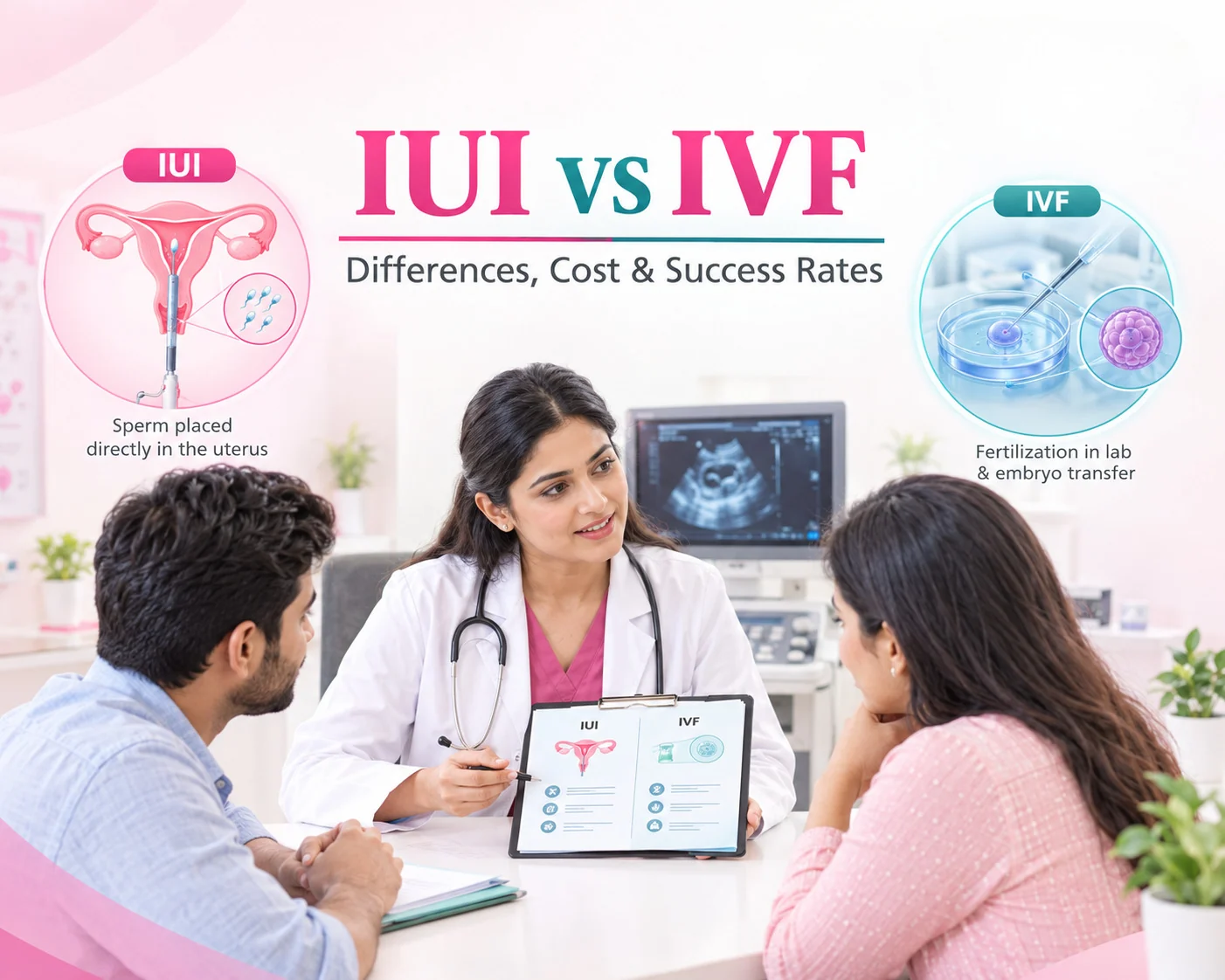
IUI vs IVF: Key Differences in Process, Cost, Success Rate & Treatment Approach
Introduction
When you begin fertility treatment, one of the first questions you will face is simple but overwhelming: IUI or IVF?
Both are established, proven treatments. Both help couples achieve pregnancy. But they work in fundamentally different ways, suit different fertility challenges, and come with very different costs and time commitments. Choosing the wrong starting point can mean months of unnecessary treatment — or, conversely, jumping to an expensive procedure you did not actually need yet.
The right answer depends on your diagnosis, your age, and what is actually happening in your body. At Divine IVF, Noida, led by Dr. Mandavi Rai, the decision between IUI and IVF is always based on a thorough evaluation — not a default protocol.
This guide breaks down the key differences so you can have an informed conversation with your specialist.
What is IUI?
IUI (Intrauterine Insemination) is a simpler, less invasive fertility treatment. A semen sample is collected, "washed" in the laboratory to concentrate the healthiest, most motile sperm, and then placed directly into the uterus using a thin, flexible catheter around the time of ovulation .
The critical point: fertilization still happens inside the body, in the fallopian tube. IUI simply gives sperm a head start by bypassing the cervix and shortening the distance they need to travel .
The IUI Process at a Glance
A typical IUI cycle involves:
Mild ovulation stimulation (often oral medication like letrozole or clomiphene) to encourage one or two mature eggs
Follicular monitoring through ultrasound scans
A trigger injection (hCG) to precisely time ovulation
Sperm preparation in the lab on the day of insemination
Insemination — a procedure that takes just a few minutes, requires no anaesthesia, and allows most women to return to normal activities immediately
What is IVF?
IVF (In Vitro Fertilization) is a more advanced assisted reproductive technology. The ovaries are stimulated with hormone injections to produce multiple eggs, which are then retrieved through a minor procedure under light sedation. The eggs are fertilized with sperm in the laboratory, and the resulting embryo is transferred back into the uterus .
IVF does in the lab what the body cannot do on its own. This is why it can succeed in cases where IUI simply cannot — blocked tubes, severe sperm problems, or age-related egg quality decline .
The IVF Process at a Glance
Ovarian stimulation with daily injections for about 10–12 days
Intensive monitoring through blood tests and ultrasound
Egg retrieval under sedation — a short procedure
Fertilization in the lab, with or without ICSI depending on sperm quality
Embryo culture for 3–5 days
Embryo transfer into the uterus
IUI vs IVF: Key Differences at a Glance
Sources:
Success Rates: What the Numbers Really Mean
IUI Success Rates
For women under 35 with favourable fertility profiles, IUI achieves a success rate of approximately 10–20% per cycle . These rates decline with age — for women over 40, IUI success is often below 5% per cycle .
Most specialists recommend trying 3–4 IUI cycles before moving to IVF, if pregnancy has not occurred. If IUI is going to work, it usually works within that window .
IVF Success Rates
IVF consistently delivers higher success rates per cycle. For women under 35, live birth rates per embryo transfer typically range from 40–60%, depending on the clinic and the patient's specific profile . Success declines with age, but IVF still holds up better than IUI in older age groups because it allows the laboratory to select the best embryo from multiple eggs retrieved in a single cycle .
At Divine IVF, reported success rates are 78% for patients under 30, 67% for ages 30–35, and 58% for ages 35–40 — reflecting the clinic's personalised approach and advanced laboratory standards.
The Important Caveat
Higher success per cycle does not automatically mean IVF should be the first step for everyone. For a 28-year-old with mild male factor infertility and open tubes, three IUI cycles may achieve cumulative success comparable to one IVF cycle at a fraction of the cost and physical toll . The right choice depends on your diagnosis, not a universal statistic.
Cost Comparison: IUI vs IVF in India
IUI Cost
IUI is significantly more affordable. In India, a single IUI cycle typically costs between ₹10,000 and ₹40,000, depending on the clinic, city, and whether fertility medication is included .
However, it is important to consider the cumulative cost. If three to four IUI cycles are attempted without success, the total spent can reach ₹60,000 to ₹1,00,000 — plus several months of time — before moving to IVF anyway .
IVF Cost
IVF is a larger investment. A single cycle in India generally ranges from ₹1.5 lakh to ₹3.5 lakh, with additional costs for advanced techniques like ICSI, genetic testing (PGT), or frozen embryo transfer .
The higher upfront cost of IVF must be weighed against its higher success rate per cycle. For some couples — particularly those over 35 or with severe fertility factors — going directly to IVF can actually be more cost-effective than multiple failed IUI attempts .
Who Should Choose IUI?
IUI is often the right first step when the fertility challenge is mild and the fallopian tubes are confirmed open .
IUI May Be Recommended For:
Unexplained infertility in younger couples
Mild male factor infertility — slightly low sperm count or motility
Cervical mucus problems that prevent sperm from reaching the egg
Ovulation disorders that respond to medication, such as PCOS
Same-sex couples or single women using donor sperm
Couples who prefer a less invasive, lower-cost starting point
A Critical Requirement
For IUI to have any chance of success, at least one fallopian tube must be open and functional. If both tubes are blocked, IUI cannot work — fertilization happens in the tube, and if sperm and egg cannot meet there, the treatment is futile .
Who Should Choose IVF?
IVF is typically recommended when IUI is unlikely to succeed, or when specific fertility barriers make natural fertilization impossible or highly improbable .
IVF May Be Recommended For:
Blocked or damaged fallopian tubes
Severe male factor infertility — very low count, poor motility, or sperm that must be surgically retrieved
Advanced maternal age (typically 35–38 and above) with declining ovarian reserve
Moderate to severe endometriosis
Failed IUI after 3–4 cycles
Recurrent pregnancy loss requiring embryo screening
Genetic testing needs (PGT) to screen embryos before transfer
When IVF May Be the First Choice
For some couples, starting directly with IVF saves time and emotional energy. If the diagnosis clearly points to IVF — blocked tubes, severe sperm problems, or age-related urgency — there is little benefit in trying IUI first .
How Many IUI Cycles Before Moving to IVF?
Most fertility specialists recommend 3 to 4 IUI cycles before considering IVF, provided the tubes are open and the sperm parameters are not severely compromised .
If pregnancy has not occurred after that many attempts, continuing with more IUI cycles is unlikely to change the outcome. At that point, IVF offers a more effective path forward.
For women over 35, some specialists may recommend moving to IVF sooner — after 2–3 cycles, or even directly — because time becomes a critical factor as egg quality declines .
The Divine IVF Approach: Personalised, Not Protocol-Driven
At Divine IVF, Sector 76, Noida, the choice between IUI and IVF is made only after a complete evaluation of both partners — hormone testing, ultrasound, semen analysis, and tubal assessment.
Dr. Mandavi Rai, with over 15 years of fertility experience and 3000+ parenthood journeys, emphasises that the right treatment is the one that matches the diagnosis, not the one that is cheapest or most advanced by default.
The clinic offers both IUI and IVF under one roof, along with advanced options including ICSI, genetic testing, and fertility preservation — ensuring that your treatment plan can evolve as your needs change, without the disruption of switching clinics.
As Dr. Rai puts it: "There is no one-size-fits-all path to parenthood. My role is to understand, guide and support you with the right care, at the right time."
FAQs
What is the main difference between IUI and IVF?
In IUI, sperm is placed in the uterus and fertilization happens naturally inside the body. In IVF, eggs are retrieved and fertilized in a laboratory, and the embryo is transferred back. IVF bypasses more natural barriers, which is why it has higher success rates per cycle .
Is IUI painful?
No. IUI is a quick procedure — usually taking just a few minutes — and most women describe it as similar to a Pap smear. No anaesthesia is needed, and you can return to normal activities immediately .
How many IUI cycles should I try before IVF?
Most doctors recommend 3–4 cycles. If pregnancy has not occurred by then, IVF is usually the next step .
Is IVF more successful than IUI?
Yes, per cycle. IVF success rates are typically 40–60% for women under 35, compared to 10–20% for IUI. However, for the right candidate, a few IUI cycles can be a reasonable and cost-effective first step .
Can I skip IUI and go straight to IVF?
Yes, in certain cases. If you have blocked tubes, severe male factor infertility, or are over 38 with declining ovarian reserve, your doctor may recommend IVF as the first treatment .
Does IUI increase the chance of twins?
The risk is low but present, roughly 5–10% when fertility medication is used, because multiple follicles may develop. IVF twin risk depends on how many embryos are transferred — single embryo transfer is now widely recommended to minimise this risk .
Conclusion
IUI and IVF are not competitors — they are tools for different situations. IUI is the gentler, more affordable first step for mild fertility challenges. IVF is the more powerful option when specific barriers make natural fertilization unlikely or impossible.
The right choice comes down to your diagnosis, your age, and a clear understanding of what each treatment can realistically achieve. Take the time to get a proper evaluation, ask direct questions, and choose a specialist who will explain not just what the treatment is, but why it is right for you.
Book a consultation with Dr. Mandavi Rai at Divine IVF, Sector 76, Noida, to discuss whether IUI or IVF is the right path for your fertility journey.
📞 Clear answers. Personalised care. The right next step.
Disclaimer: Fertility treatment outcomes vary by individual medical profile. This information is for educational purposes and is not a substitute for personalised medical advice. Consult a qualified fertility specialist for guidance specific to your situation.