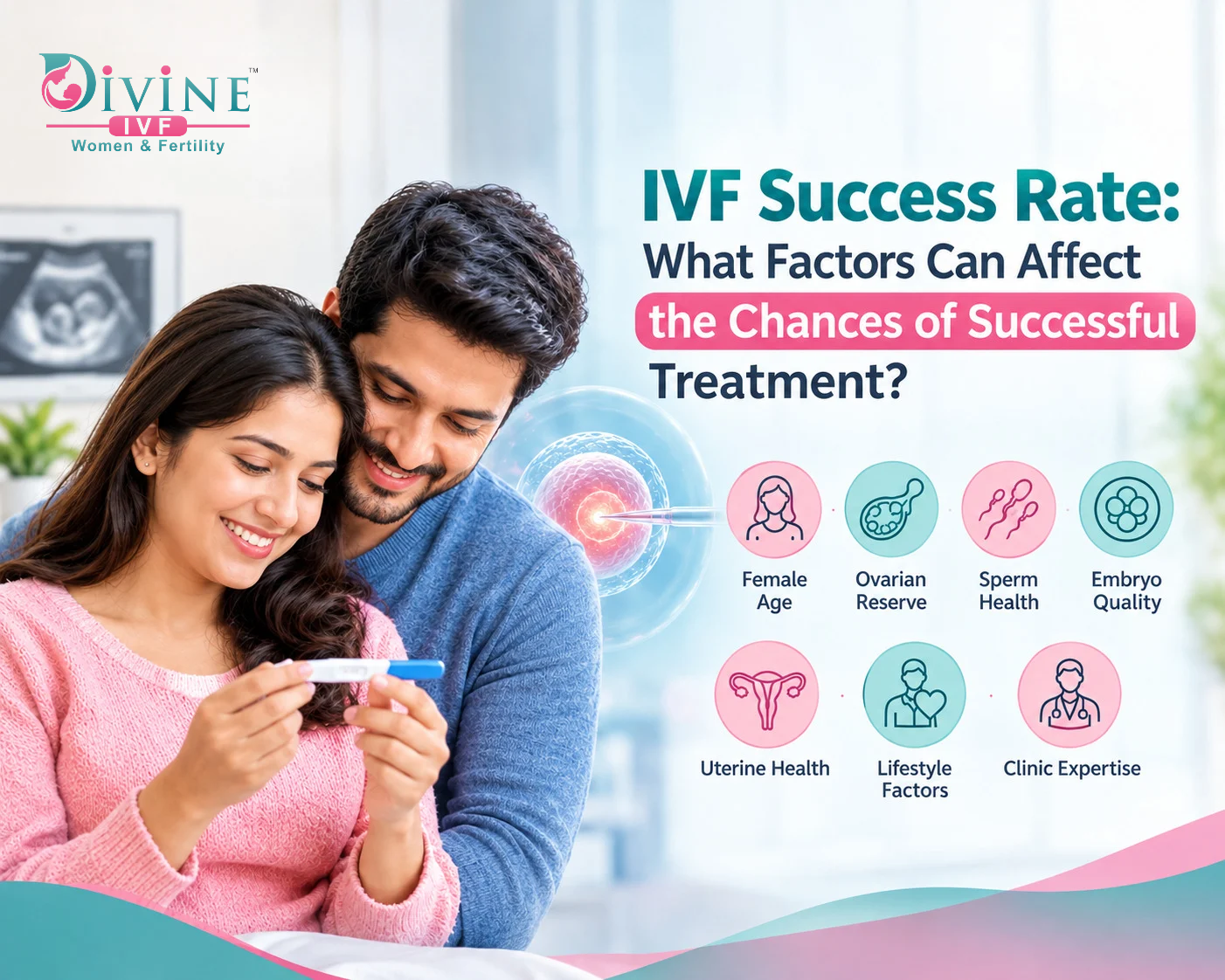
IVF Success Rate: What Factors Can Affect the Chances of Successful Treatment?
Introduction
If you are considering IVF or have already started your fertility journey, one question sits at the centre of everything: What are my chances?
It is a fair question. IVF is a significant emotional, physical, and financial commitment. And while no clinic or doctor can promise a specific outcome, understanding the factors that influence IVF success helps you make informed decisions, set realistic expectations, and — most importantly — know what you can actually control.
At Divine IVF, Noida, Dr. Mandavi Rai has guided over 3,000 parenthood journeys in 15+ years of dedicated fertility practice. In this blog, we break down the key factors that affect IVF success rates — honestly, clearly, and without false promises.
First, What Does "IVF Success Rate" Actually Mean?
Before diving into factors, it is important to understand what success rates are measuring. Different clinics quote different numbers, and they don't always mean the same thing.
Clinical pregnancy rate: A pregnancy confirmed by ultrasound (gestational sac visible).
Live birth rate: The birth of a live baby — the outcome that truly matters.
Per cycle vs. per embryo transfer: Success can be measured per started cycle or per completed transfer.
A clinic reporting a "50% success rate" might be quoting clinical pregnancy per transfer, not live birth per cycle. Always ask which measure is being used.
At Divine IVF, the focus is on honest, transparent communication — you will know exactly what each number means for your situation.
The Factor You Cannot Change: Female Age
Female age remains the single most influential factor in IVF success. This is not about blame or pressure — it is simply biology.
The reason is egg quality and quantity. Women are born with a finite number of eggs, and both the number and the proportion of chromosomally normal eggs decline with age. This decline tends to accelerate in the mid-to-late thirties.
Here are approximate live birth rates per IVF cycle by age group, based on patterns reported across Indian and international fertility clinics:
These are broad ranges. Your individual odds depend on many factors beyond age alone — as you will see below.
Ovarian Reserve: How Many Eggs Are Available?
Ovarian reserve refers to the number of eggs remaining in the ovaries. It is measured through:
AMH (Anti-Müllerian Hormone): A blood test that estimates egg supply.
Antral Follicle Count (AFC): An ultrasound count of small follicles.
A higher ovarian reserve generally means more eggs can be retrieved in a cycle, which increases the chance of having at least one healthy embryo to transfer.
However, there is an important nuance. Research shows that while AMH and AFC are strong predictors of how many eggs you will get, their direct correlation with live birth is more limited. What matters more is egg quality — and that is more closely linked to age than to reserve numbers.
A study published in Fertility and Sterility found that for women with diminished ovarian reserve, the ability to reach a chromosomally normal (euploid) embryo transfer was greater in younger women. But once a euploid embryo was transferred, live birth rates were comparable across age groups. In other words: the challenge is getting a healthy embryo, not necessarily carrying it.
Male Factors: More Important Than Often Acknowledged
IVF success is not just about the woman. Male factors contribute significantly to outcomes.
Male Age
Research involving nearly 6,000 IVF cycles found that increasing male age is associated with lower rates of embryo euploidy — meaning fewer chromosomally normal embryos. This effect was observed even in women under 35, suggesting that paternal age independently influences embryo quality.
Sperm Parameters
Semen analysis remains a cornerstone of fertility evaluation. Key parameters include:
Sperm concentration
Progressive motility
Normal morphology
Studies show that lower sperm concentration and motility are associated with lower fertilization rates and fewer blastocysts developing. Even the change in total motile sperm after sperm washing can predict future IVF outcomes — a greater decline during preparation may reflect underlying sperm quality issues not detected by routine analysis.
This is why a comprehensive male evaluation is not optional. At Divine IVF, male and female fertility are assessed together, always.
Embryo Quality and Stage: The Direct Predictor
The embryo itself is the most direct predictor of IVF success. Key factors include:
Number of blastocysts: Having more blastocysts (Day 5 embryos) increases the chance of selecting a viable embryo for transfer.
Embryo grade: Morphological quality is assessed by the embryologist.
Chromosomal normality (euploidy): Even a good-looking embryo can have chromosomal abnormalities. Preimplantation genetic testing for aneuploidy (PGT-A) can identify chromosomally normal embryos, improving the chance of a successful transfer.
One study found that the number of high-quality embryos available is a significant predictor of clinical pregnancy outcomes. Another study noted that having supernumerary (extra) embryos available for freezing may indicate better overall embryo quality.
Uterine and Endometrial Factors
The uterus must be receptive for an embryo to implant. Factors that can affect this include:
Endometrial thickness: Measured on the day of the trigger shot, adequate thickness is associated with better outcomes.
Uterine abnormalities: Fibroids, polyps, or adhesions may interfere with implantation.
Endometriosis: Can affect both egg quality and uterine receptivity.
A specialist will evaluate these factors before planning your transfer strategy.
Lifestyle Factors You Can Actually Control
Unlike age, several factors are within your control — and making changes can genuinely improve your odds.
Smoking
This is one of the most consistent findings in fertility research. A comprehensive meta-analysis confirmed that non-smokers are significantly more likely to achieve pregnancy or live birth than smokers. Smoking reduces IVF pregnancy rates by about half and increases miscarriage risk. Stopping smoking for at least 3–6 months before treatment is strongly recommended.
Body Mass Index (BMI)
The evidence on BMI is more mixed, but a clear pattern emerges for women using their own eggs. Elevated BMI is associated with lower odds of achieving pregnancy. Interestingly, this effect appears less pronounced in donor egg cycles, suggesting that BMI may influence outcomes partly through its effect on egg quality.
A healthy BMI (18.5–24.9) is generally associated with the most favourable outcomes.
Alcohol
The evidence on alcohol is less conclusive than for smoking, but moderation or avoidance during fertility treatment is generally advised.
The Clinic and Laboratory: The Factors You Choose
IVF is a highly technical procedure, and the skill of the clinic and laboratory matters enormously.
Key considerations include:
Embryology lab quality: The environment where embryos are cultured — air quality, temperature control, and embryologist expertise — directly affects embryo development.
Doctor experience: A fertility specialist trained in reproductive medicine brings focused expertise that general practitioners may lack.
Individualised protocols: No two patients respond the same way to stimulation. A protocol tailored to your age, reserve, and history optimises your chances.
Advanced techniques: Options like ICSI, PICSI, IMSI, and time-lapse monitoring can be appropriate for specific cases.
The CDC notes that some clinics accept more difficult cases than others, which can affect reported success rates. A lower number from an honest clinic may reflect a more challenging patient population, not poorer care.
Understanding That Averages Are Not Predictions
It is easy to look at a success rate table and either feel reassured or discouraged. But here is the truth: national or clinic-wide averages are not personal forecasts.
Two women of the same age can have very different odds depending on their ovarian reserve, sperm health, uterine condition, and fertility history. What actually helps is:
A proper diagnostic workup
An honest conversation about where your case sits within the ranges
A specialist who explains the reasoning behind each recommendation
Conclusion: Knowledge Is Power
IVF success is influenced by a complex interplay of factors — some fixed, like age, and some modifiable, like smoking and BMI. Some are determined by biology, and some by the choices you make about where and with whom you receive care.
What you can do:
Get a comprehensive evaluation — both partners
Address lifestyle factors that are within your control
Choose a clinic with a dedicated fertility specialist and a strong laboratory
Ask questions — understand your individual prognosis, not just clinic averages
At Divine IVF, Noida, Dr. Mandavi Rai combines 15+ years of fertility expertise with a doctor-led, individualised approach. Every plan is shaped by your specific history and circumstances — because there is no one-size-fits-all path to parenthood.
Ready to understand your individual chances? Book your consultation with Dr. Mandavi Rai at Divine IVF, Noida and start with a clear, personalised plan.